
NHS Pilot Programme Case Study


Overview
Through a discovery and feasibility study, there are at least ~80 million outpatient appointments within England itself and 20% of the appointments were lapsed or missed due to the lack of manpower or knowledge of nearby outpatient care.
The need to create significant new elective capacity using virtual care for NHS patients - drawing on NHS, cross-sector and international experience - to significantly reduce NHS waiting lists. It has found significant clinician support for standardised virtual patient pathways, delivered through a single national technology stack by a flexible clinical workforce, managed as a new national NHS virtual care provider is best placed to maximise the benefits of virtual care (rather than each local NHS Trust increasing local models of virtual care).
Goals
-
Test pilot programme to streamline appointment bookings for patients and clinicians with the creation of a virtual hospital
-
Reduce friction caused by double bookings and information gaps caused by use of multiple platforms
-
Reduce traditional booking by 70% to optimise workflow among healthcare professionals
Role & Task
Service & Lead Designer
Video Post Production
Duration
32 Weeks (Pilot Phase)
Tools
Figma
Miro
Adobe Aftereffects
Platform
Desktop / Mobile
Problem statement
Elective care within the NHS faces growing backlogs and capacity constraints that delay timely treatment that cause lapsed in patients receiving the right care for better outcomes.
Research
-
Conducted roundtable discussions and workshops with clinicians supplemented with 1-1 interviews
-
Surveys with caregivers and patients
-
Onsite field groundwork in selected NHS clinics (England)
-
Understanding journey of both patient pathways and clinician processes

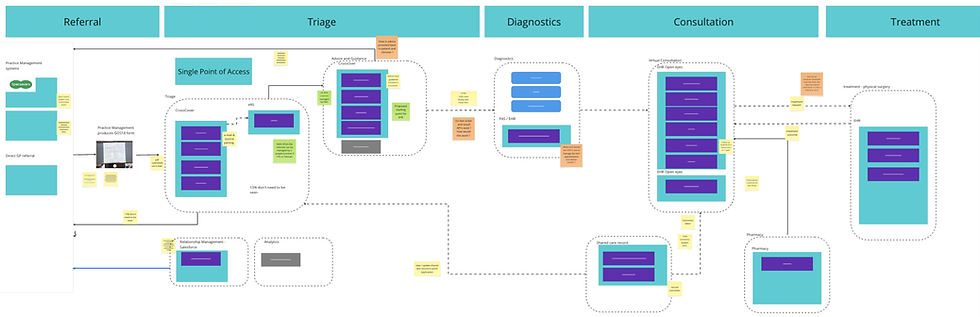
Current frictions identified
Based on a single Urology pathway, at least 6 different systems and platforms were used for a single patient's appointment which caused loss of information and booking disruptions to both clinicians and patients. This also increased the need for multiple compliance check when transfer data from one system to another, causing unnecessary loss in time and decrease in patient outcomes.
1 - Referral
Generally done in paper form but a small minority of the patients are referred digitally (dependent on clinics)
2 - Triage
A standalone 3rd party platform pulling data from the referral system which is primarily done via paper records or lapsed due to backlogs
3 - Diagnostics
Healthcare records can only be pulled in specific areas within the UK and data are not shared cross region.
Data are stored differently for different disease pathways.
4 - Consultation
Majority of consultations are done face to face physically which some non-emergency cases can be done remotely
5 - Treatment
Clinicians are unable to review available slots at clinics in a real time setting. Patients unable to check for appointment information digitally
6 - Post op Care
Patients are only able to obtain physical education materials or digital post care materials on separate websites which may be overlooked
Concept and individual pathways
A distinct digital platform is essential to both pathways.
Clinicians:
A platform to allow referral and triaging of patients, reviewing patient health data on a single platform, booking of diagnostic and treatment appointments with a feature to allow healthcare professionals to monitor any non-compliance or indicators for the patient.
PATIENT PLATFORM
HEALTHCARE PROFESSIONAL PLATFORM
Improving patient's experience with the adoption of telemedicine
to reduce unnecessary waiting time for clinic visits
Clinician's core features
Optimising the flow and features for clinicians and administrators
-
2-Way Communication among clinicians
-
Diagnostic and test centers scheduling system
-
Patient journey overview
-
Patient notes review
-
Consultation notes to include diagnostic images
-
Admin overview and ability to review urgent cases
-
Telemedicine capability

PATIENT OVERVIEW FOR CLINICIANS
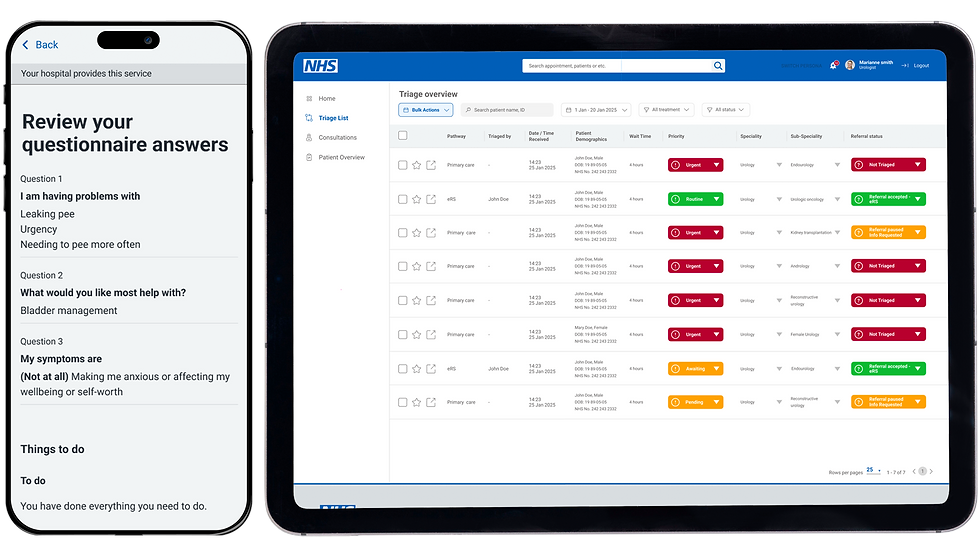
Triaging System
Health system administrators are able to triage patients in accordance to their medical emergency and urgency.
Clinicians will be able to review patients being triaged to them and follow through their treatment journey.
Rejections, Query and Acceptance can be performed at this stage to filter patients


Referral Tab
Clinicians are able to review referral and referrer informations that will be uploaded from NHS patient portal.
Clinicians will be able to make informed decisions by reviewing the questionnaires done by the patient.

Diagnostics Review
Patient's previous diagnostic results will be accessible for clinicians with the capability to review file imaging extensions used by radio imaging systems.
Quick button allows clinicians to book follow up diagnostic tests if required.
Patient Overview Dashboard
Clinicians are able to see patient's current state in the treatment journey.
All medical history are consolidated in the dashboard for clinicians to access and review easily.
Medications history are recorded to prevent any adverse events from multiple medication.

Correspondence System
Treating clinicians are able to make two way communications between each other to seek for advice regarding patients.
Clear audit trial of all messages to for historical reviews.

Telemedicine (Virtual Consultation) reduces the need for travel,
and enables timely medical support through digital technology.
Real time transcribing with patient's notes available for easy viewing.
3. Virtual Consultation

Reviewing up-to-date information on the patient prior to the consultation.
2. Pre-Consultation Patient Review

Clinicians will be able to review daily's consultation and accept any available cases if any.
1. Consultation Schedule List

Patient's notes post review with recommendations and AI review
4. Post Consultation

Clinician's review and advice notes for diagnostic and follow up recommendations for patient.
5. Patient Appointment Notes

Driving patient adherence is critical to successful treatment outcomes, and this system empowers administrators with clear, end-to-end visibility into each patient’s care journey.
System Administrator Dashboard
A page dedicated to review the clinic's capacity and key compliance metrics and resources in the clinic.


Appointments Dashboard
An added layer of diagnostic compliance enables administrators to proactively prevent missed appointments and dynamically match patients with available clinicians in real time, significantly reducing wait times.
Pilot Usability Test in Real World Setting
The virtual hospital was deployed in a test environment among 30 clinicians and ~300 patients that joined the program after signing a consent form.
95%
Task Success Rates
Majority of the clinicians were able to triage a patient properly right from the beginning to booking and conducting a virtual consultation with the patient.
<2%
Error Rate
The users commented that the platform was intuitive and able to capture the patient journey from 0-1 effectively.
Required follow up action buttons were located easily.
>50%
Decrease in waiting time
Diagnostic and follow up appointments were decreased dramatically as the results show that majority of the patients waiting time reduced from 4 days to 2 days for a follow up consultation via telemedicine tools.
More case studies


